
Circular Manufacturing·July 18, 2026· 10 min read
The Hidden Plastic Mountains in Our Communities
Why Saskatchewan's broken garbage bins could become Canada's next circular economy success story.
Every week, broken curbside carts quietly disappear from our streets. Most of us never stop to ask where they go. The answer reveals one of Saskatchewan's largest hidden plastic waste streams — and one of its greatest circular opportunities.
Every week, broken curbside garbage carts quietly disappear from our streets. A city truck picks them up. A replacement arrives. Life goes on.
Most of us never stop to ask a simple question: where do all the broken bins go?
As it turns out, the answer reveals one of Saskatchewan's largest hidden plastic waste streams.
A plastic mountain hidden in plain sight
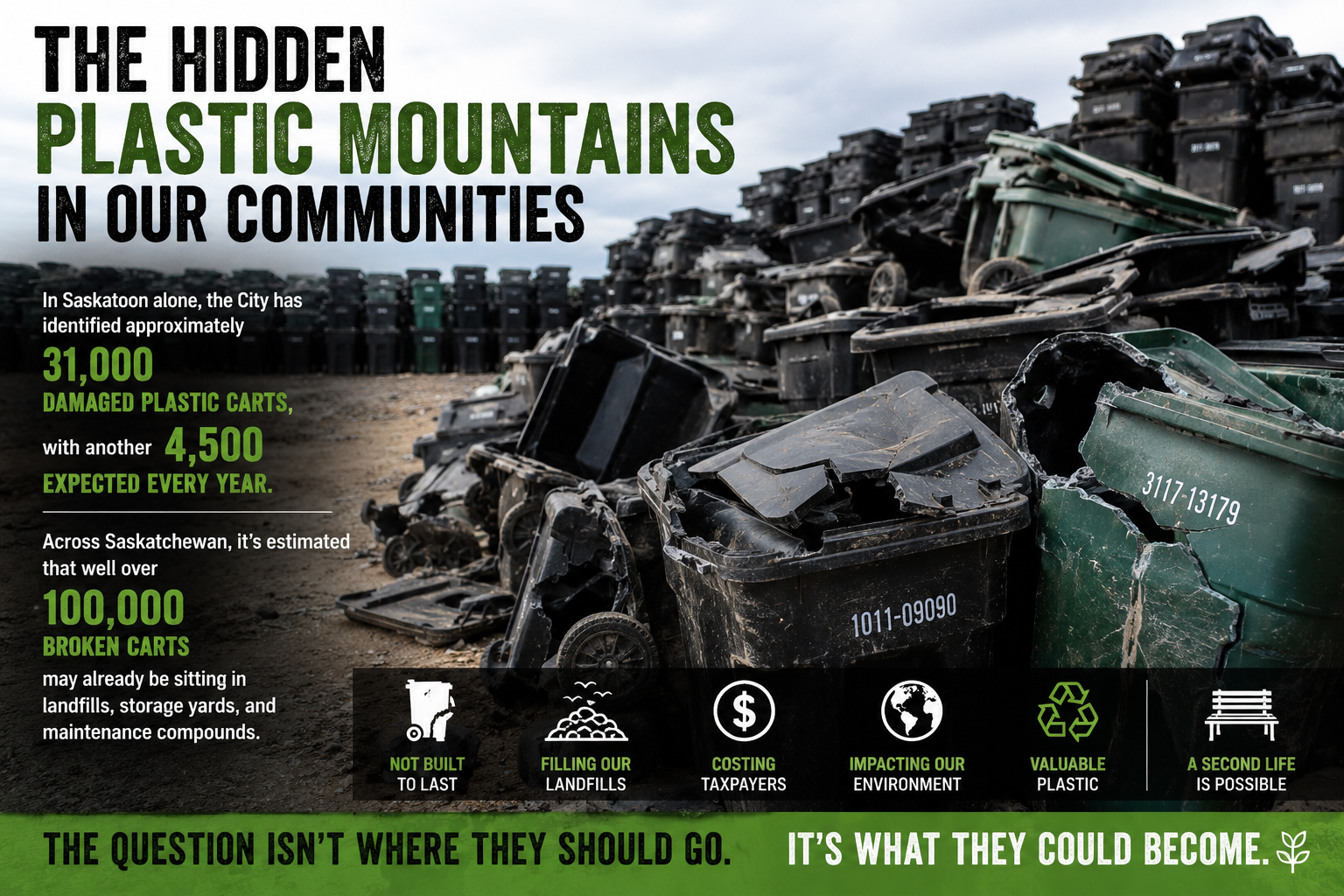
In 2026, the City of Saskatoon publicly acknowledged that it had approximately 31,000 damaged HDPE garbage carts requiring management, with another 4,500 damaged carts expected every year.
Think about that for a moment. That's more than twelve broken bins every single day. Every year. And Saskatoon is just one city.
Across Saskatchewan, broken carts can be found at municipal yards, maintenance facilities and landfills. Some communities store them for years. Others repair them. Others send them elsewhere for processing. Some are eventually disposed of.
Based on observations from multiple Saskatchewan communities, it is reasonable to believe the province may have well over 100,000 damaged carts awaiting their next chapter. Determining the exact number will require further public reporting and municipal data.
“This is not a small waste problem. It is a significant resource opportunity.”
Built for the job… so why are they failing?
Modern municipal waste carts are marketed as durable infrastructure designed to withstand years of service. Yet municipalities continue replacing thousands every year. Why?
The answer is likely more complicated than many people realize. Possible contributing factors include extreme Canadian winters, repeated mechanical lifting by automated collection trucks, heavy or frozen waste, ultraviolet weathering, material fatigue, collection impacts and handling damage, and aging plastic polymers.
Without detailed engineering studies, it would be irresponsible to point to a single cause. But the growing number of damaged carts raises important questions: How long are these carts actually lasting? What are municipalities spending to replace them? How many are repaired versus discarded? Are valuable plastics being recovered? Could Saskatchewan do something better?
The hidden cost to taxpayers
When a garbage cart breaks, the cost doesn't end with buying another one. Communities also pay for collection and replacement, labour, transportation, storage, repairs, processing, administration, disposal, and lost landfill capacity. Then the cycle begins again.
What appears to be “just another broken garbage bin” may actually represent hundreds of dollars in lifetime public costs. Multiply that by tens of thousands of carts and the numbers become staggering.
The plastic isn't garbage
Here's the exciting part. Most curbside carts are manufactured from high-density polyethylene (HDPE) — one of the world's most versatile engineering plastics.
HDPE can be transformed into outdoor furniture, park benches, planters, boardwalks, trail infrastructure, retaining walls, landscape products, marine applications, construction products, and thousands of other durable goods.
In other words — the material itself isn't broken. Only the product is.
“The material itself isn't broken. Only the product is.”
From waste management to resource management
For decades, our waste systems have focused on one question: “Where do we put this?” The circular economy asks something entirely different: “What can this become?”
That shift changes everything. Instead of treating plastic as the end of a product's life, we begin treating it as the beginning of another.
A new vision for Saskatchewan
Imagine if municipalities no longer paid to move broken plastic around the province. Imagine if those same materials became beautiful custom park benches, community gathering spaces, trail systems, riverfront seating, bus shelters, public art, school outdoor classrooms, and Indigenous-designed community infrastructure — all manufactured right here in Saskatchewan.
Instead of exporting waste, we could export innovation. Instead of filling landfills, we could fill parks. Instead of importing more virgin plastic, we could manufacture with resources we already own.
Circular manufacturing is local economic development
Every tonne of plastic we recover creates opportunities — for local manufacturers, designers, engineers, welders, truck drivers, machine operators, students, researchers, Indigenous partnerships, and municipalities.
The circular economy isn't simply an environmental strategy. It's an economic development strategy.
The eight principles of the circular future
At EcoScapes, we believe tomorrow's communities will be built around eight simple ideas: Regenerate ecosystems rather than deplete them. Replicate products locally using advanced manufacturing. Repair instead of replace. Recharge with renewable energy. Recondition materials for another life. Encapsulate difficult waste into durable products. Renew resources responsibly. Reimagine waste as opportunity.
These principles don't just reduce waste. They create stronger communities.
This is only the beginning
The broken garbage bins sitting quietly behind our landfills are more than discarded plastic. They represent a question. What kind of future do we want? One where valuable materials are buried? Or one where yesterday's waste becomes tomorrow's infrastructure?
At EcoScapes, we believe Saskatchewan has an opportunity to lead North America in circular manufacturing. Not because we have more waste — but because we have more imagination.
Over the coming months, we'll continue exploring how many broken carts exist across Canada, what they cost taxpayers every year, why they're failing, what materials are being lost, and how municipalities can keep those resources circulating within their own communities.
Because the future isn't about managing waste. It's about designing a world where waste no longer exists.
“The future isn't about managing waste. It's about designing a world where waste no longer exists.”
Call to action
Do you know of a stockpile of broken municipal bins, industrial plastics, or other overlooked waste streams? We're building Canada's first visual map of hidden plastic mountains and investigating how circular manufacturing can transform them into community assets.
If you've seen a stockpile in your community, we'd love to hear from you. Together, we can uncover the hidden resources already sitting in our own backyards and build a cleaner, more resilient future.
Shop the Look
Pieces from the dispatch.
Suggested Reading

